Dual Contouring of Signed Distance Data
3 Technion 4 University of Southern California

Abstract
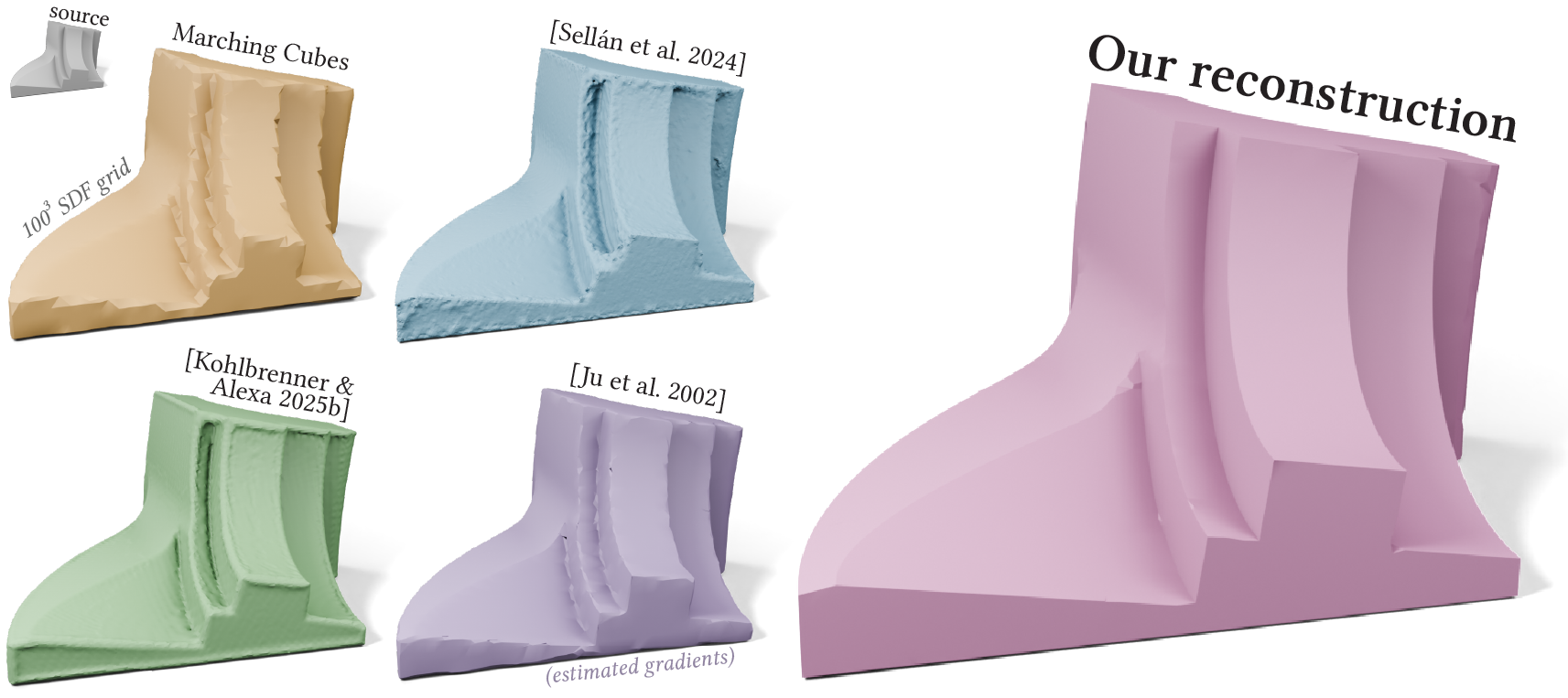
We propose an algorithm to reconstruct explicit polygonal meshes from discretely sampled Signed Distance Function (SDF) data, which is especially effective at recovering sharp features. Building on the traditional Dual Contouring of Hermite Data method, we design and solve a quadratic optimization problem to decide the optimal placement of the mesh's vertices within each cell of a regular grid. Critically, this optimization relies solely on discretely sampled SDF data, without requiring arbitrary access to the function, gradient information, or training on large-scale datasets. Our method sets a new state of the art in surface reconstruction from SDFs at medium and high resolutions, and opens the door for applications in 3D modeling and design.
Cite as
@inproceedings{Carrera2026DCSDD,
  author = {Carrera, Xiana and Wang, Ningna and Batty, Christopher and Stein, Oded and Sell\'{a}n, Silvia},
  title = {Dual Contouring of Signed Distance Data},
  year = {2026},
  isbn = {9798400725548},
  publisher = {Association for Computing Machinery},
  address = {New York, NY, USA},
  url = {https://doi.org/10.1145/3799902.3811116},
  doi = {10.1145/3799902.3811116},
  booktitle = {Proceedings of the Special Interest Group on Computer Graphics and Interactive Techniques Conference Conference Papers},
  articleno = {38},
  numpages = {12},
  series = {SIGGRAPH Conference Papers '26}
}Acknowledgments
The Geometry and the City lab at Columbia University is supported by generous gifts from nTop, Adobe, Dandy, and Braid Technologies, as well as by a sponsored research project from Dreamsports and the Columbia Engineering Interdisciplinary Research Fund.
Christopher Batty acknowledges the generous support from the Natural Sciences and Engineering Research Council of Canada (Grant RGPIN-2021-02524).
Oded Stein acknowledges the generous support from the National Science Foundation (award #2335493) and a gift from Adobe.
We thank the authors of the 3D models used throughout this paper for making them available for academic use. See the paper for a complete list of the models and their sources.